How can a robot place an item on a cluttered desk
Spatial optimization and trajectory planning for a Baxter service robot.
TL;DR: Developed and implemented spatial optimization and trajectory planning algorithms to enable a Baxter service robot to autonomously evaluate and place items on a cluttered 2D surface.
Technologies & Methodology
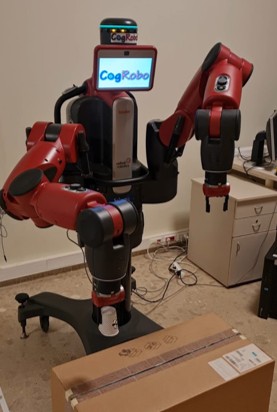
- Hardware: Baxter Service Robot (Dual 7-DOF arms).
- Software & Frameworks: ROS (Kinetic/Noetic), MoveIt! trajectory planning, Gazebo 11 simulation environment, Python.
- Algorithms Investigated: Greedy Packing, AABB (Axis-Aligned Bounding Box) Trees, and Gridization-Based Hierarchical Placement.
Key Contributions & Results
- Transformed the physical desk environment into a 2D coordinate system and approximated items as rectangle bounding boxes to efficiently frame the task as a packing problem.
- Engineered a recursive blank space detection algorithm and a greedy packing algorithm that selects optimal placements using Candidate Corner-Occupying Actions (CCOA) to minimize computational overhead.
- Successfully planned and executed collision-free pick-and-place kinematics in both Gazebo simulations and on the physical Baxter hardware using MoveIt!.